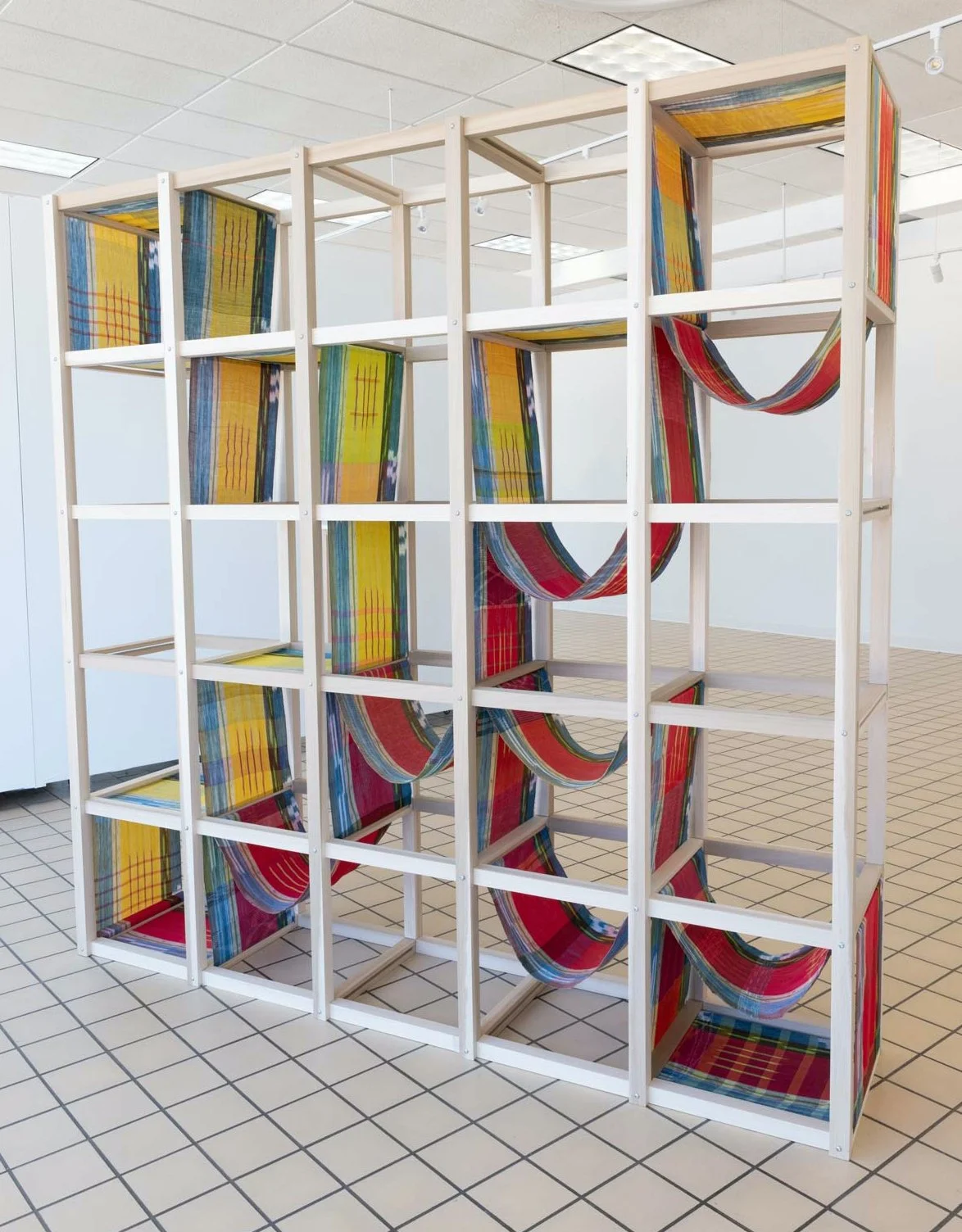
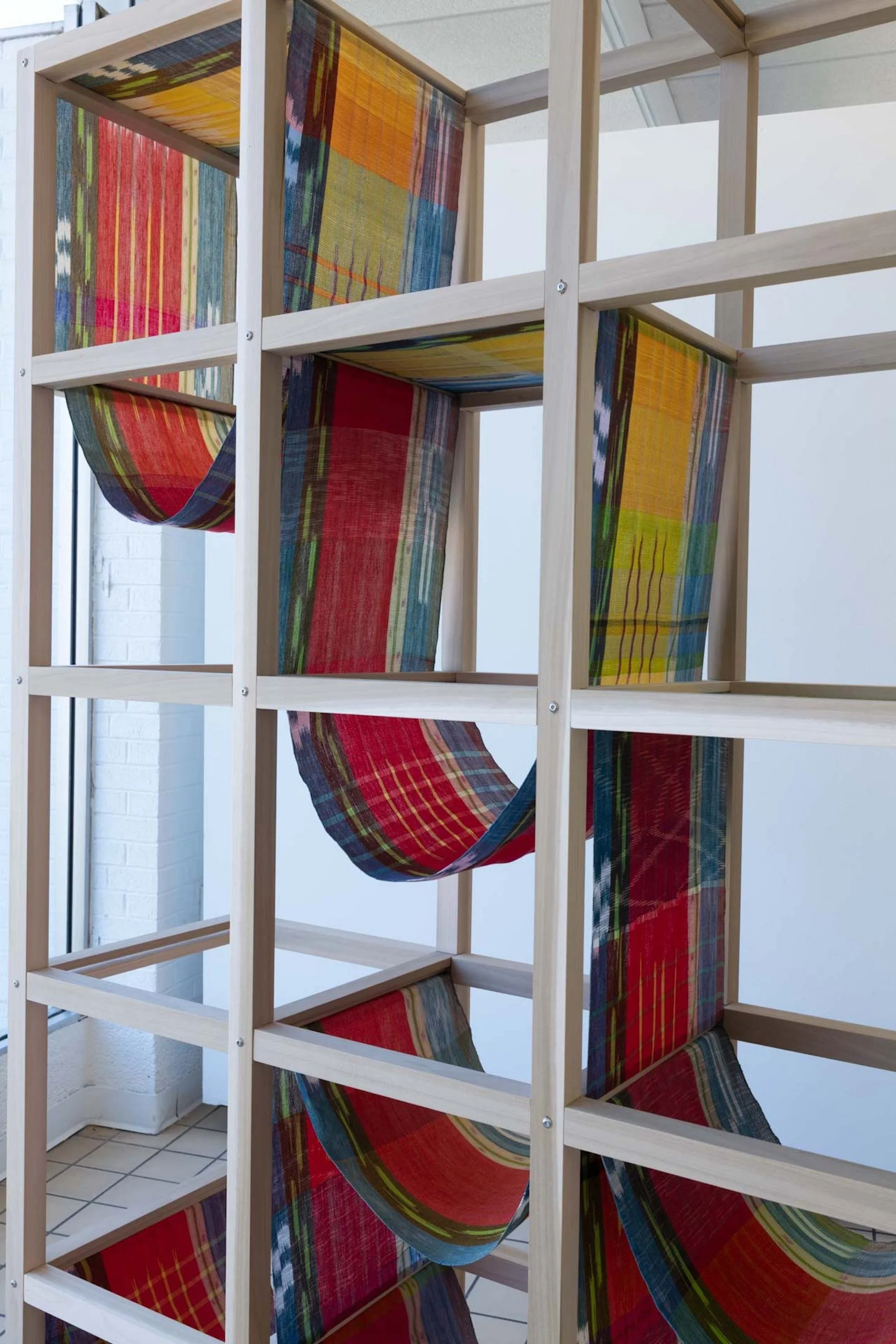
to float, blurred (ひぶんしょう)
2026
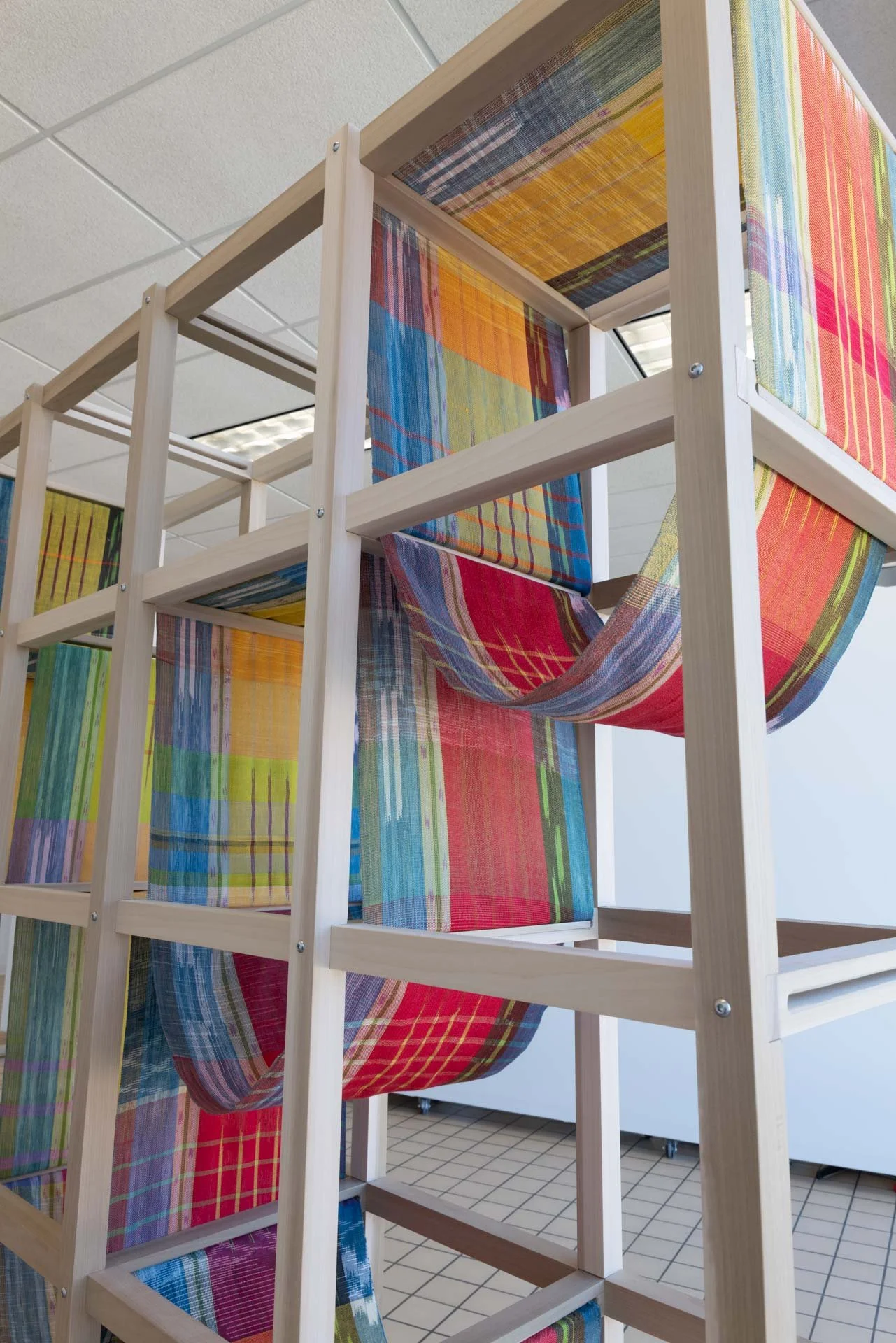
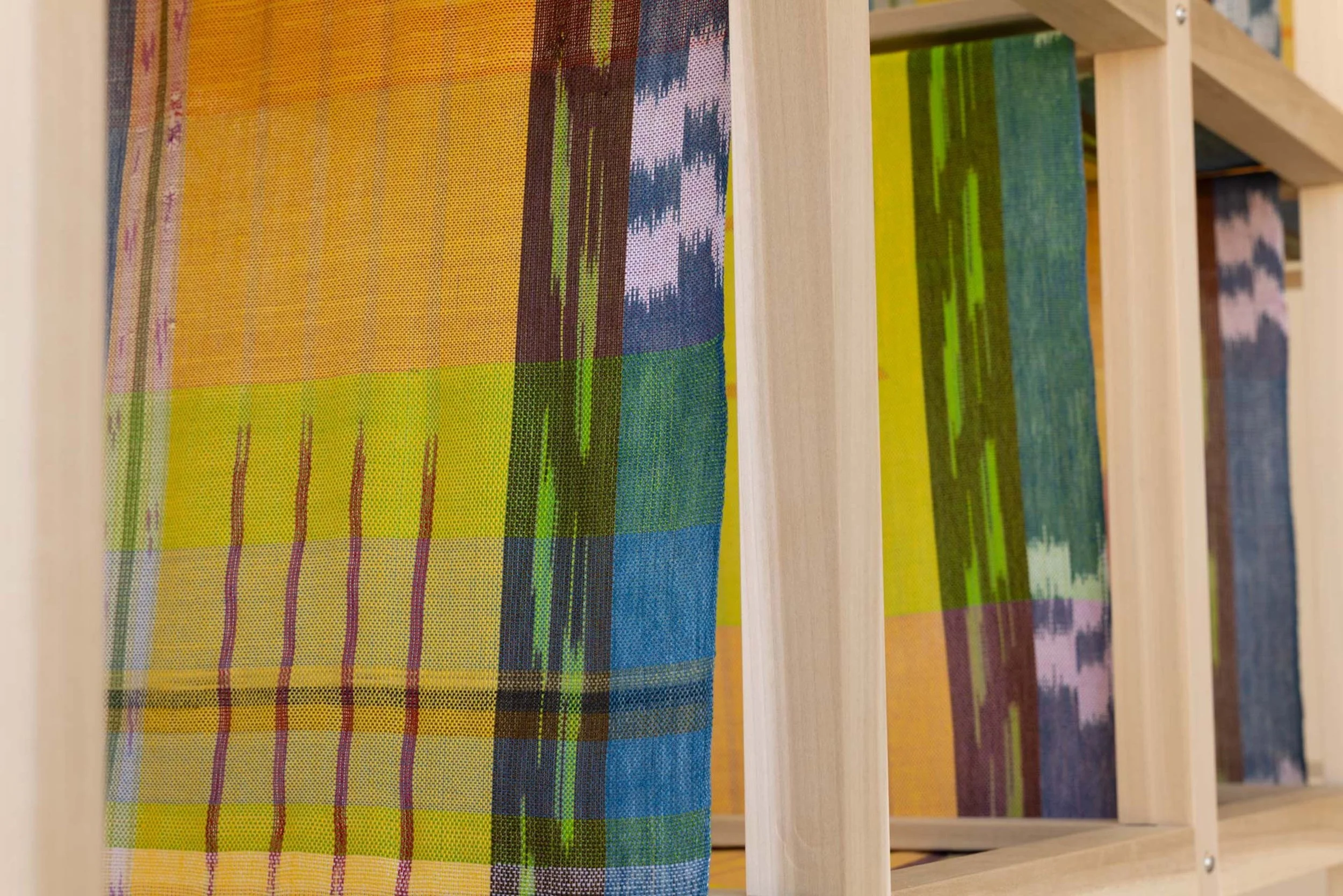
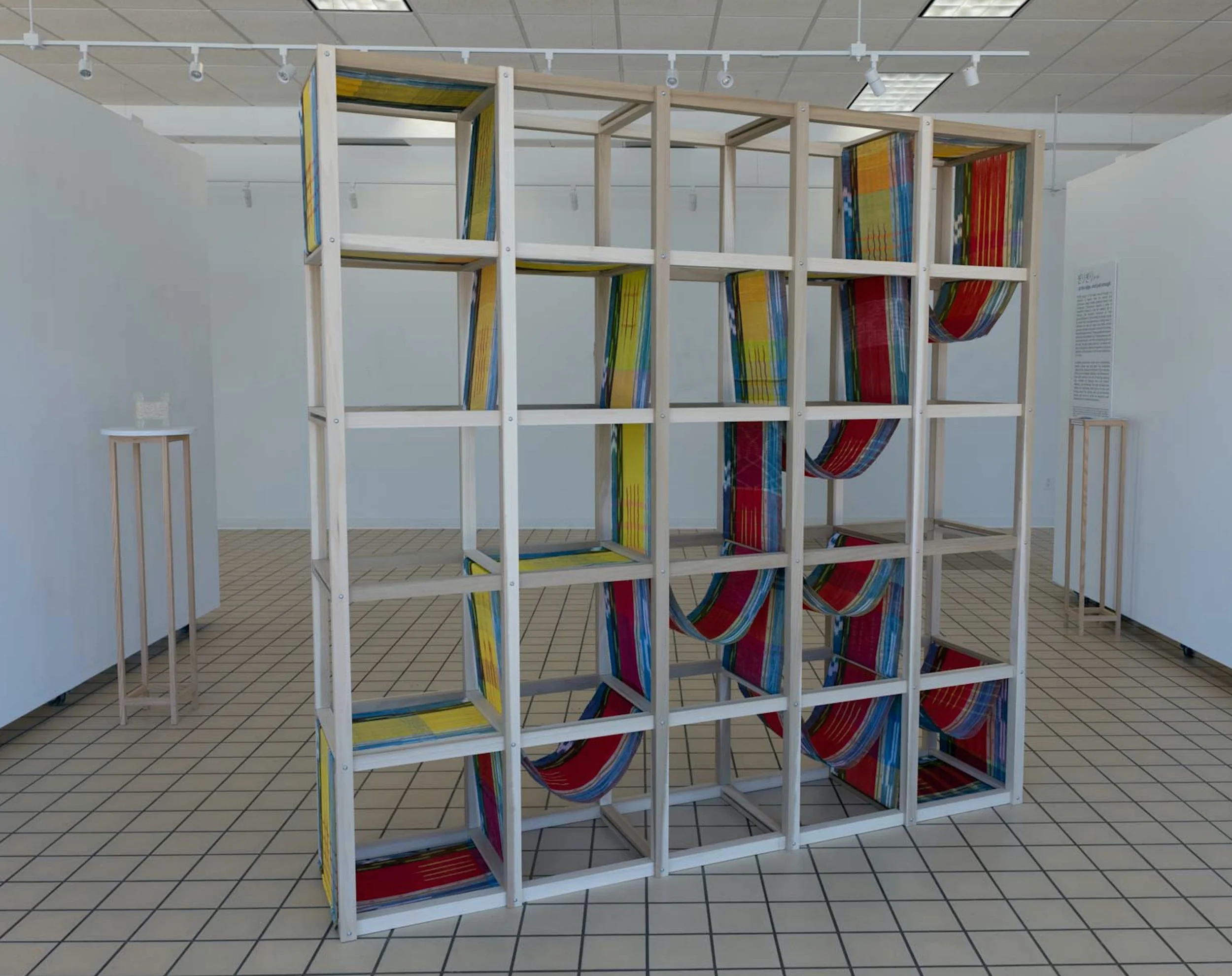
Hand dyed kasuri (resist tied) cotton warp, indigo and MX dyes, cotton, lurex, shifu paper and basho yarn, poplar wood frame by Sylvie Rosenthal
7’ x 7’ x 18”
photos by Mariah Moneda
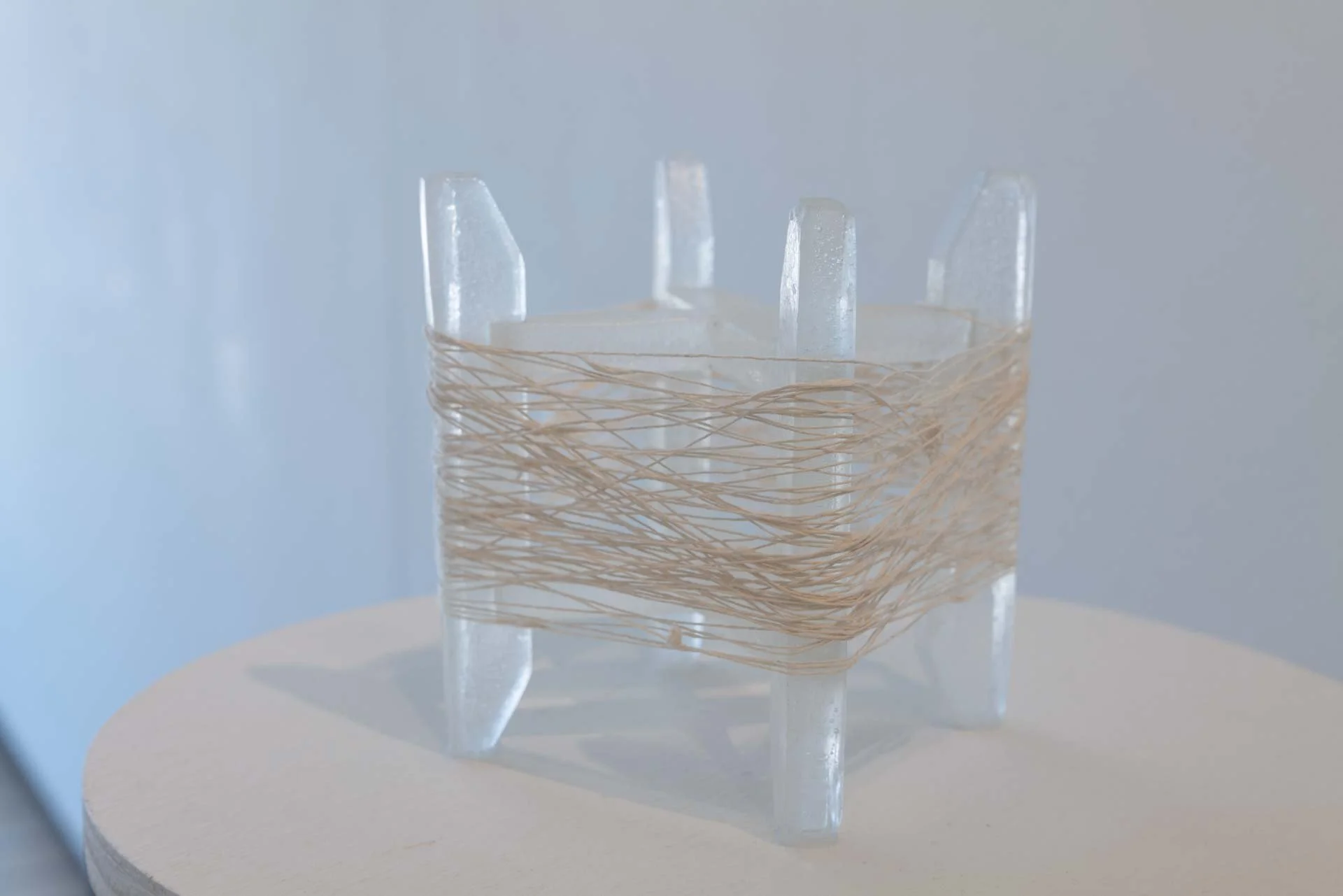
kiwaku
2026
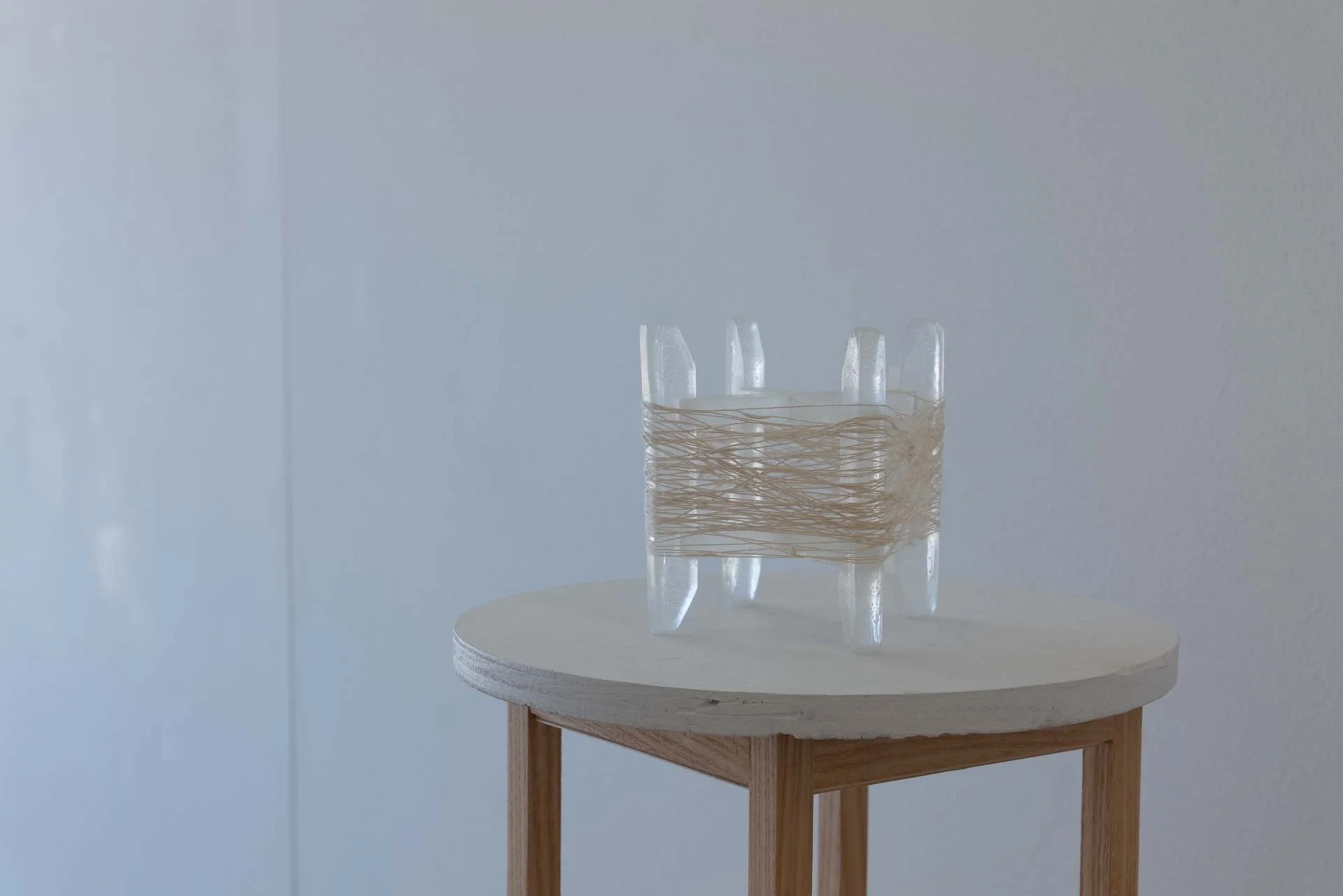
cast glass and shifu paper yarn
5.75” x 4.75” x 4.5”
photos by Mariah Moneda
My material relationships expand my notion of home. Through them I learn about bodily intricacies; they are surprising, boundaried, and tender teachers. I see my studio practice as one of learning to listen in all senses.
This latest body of work explores the haunting familiarity I found during a research trip to Okinawa last summer. My great-grandparents on my father’s side emigrated to Hawai’i from the Ryukyu Islands, now called Okinawa. It was my first time visiting, but parts of the place felt like mirrors of home. Both have an intense U.S. military presence that has forever altered the landscape and pushed animals to extinction. I was nostalgic finding the red clay dirt that I grew up with staining my feet, before researching how this signals depletion in soil from construction and agriculture, leading to red rings of runoff during heavy rain that block the sun and bury coral in the ocean. Both have had their indigenous languages banned and near extinction, with six Okinawan languages endangered. I have walked past sugar cane fields for long stretches, seeing no one, because the bus routes cannot accommodate the landscape. There were orchids everywhere, thriving on trees or the tops of cinderblock walls, and I remembered my grandparents’ gardens, when I thought they were the only ones who could manage such abundance. There is the ocean, which I am told my great grandmother walked through at low tide with her books above her head to go to school, although I cannot tell you from where she was heading.
There are small pouches of salt, maasu bukuro, that offer protection and good fortune. The bags, beautifully woven, is where the memory of Okinawa feels more like something my body knows than a lived experience. Soetsu Yanagi wrote of Okinawa’s Bashofu, a cloth woven from the inner stalks of the Japanese fibre banana tree, in 1939. In his essay he writes of Kijoka, “where every house emits the sounds of looms.” He talks about the quality and abundance of material, natural indigo fermentation that happens without much oversight, natural dyeing that requires no mordants: “It is almost as if Okinawa were created for the making of bashofu.” The place does feel that way, with a humidity unlike anything I have experienced before. This too, feels like listening.
Yanagi does not write about the Kijoka bashofu fields being burned in 1945 by the US military, which they argued was to curb the threat of mosquitos and malaria. Toshiko Taira, daughter of a bashofu weaver and Living National Treasure for her revival of bashofu fabrics, had volunteered for a munitions factory during the war in mainland Japan. On returning to Naha, she described the entire city as burnt, with tent houses everywhere. It is estimated that there were around 150,000 civilian casualties in the Battle of Okinawa, or roughly a third of the population killed or coerced into suicide.
With the bashofu fiber gone, those in Kijoka took to unweaving tents, gloves, and socks to have fiber to weave. Taira tells of the creativity she utilized during this time to make the work she wanted; foraging dyes, remaking ruined tools, like temples out of pig bone. She found ways to make woven products and employ the women of Kijoka, to revive their town’s history of weaving. These souvenirs, bought in airport gift shops, popular with Americans.
My piece to float, blurred (ひぶんしょう),conflates these personal and ancestral histories into twenty yards of kasuri resist-dyed fabric, wrapped around a large wooden frame. The yardage is roughly 14” wide, the standard width of kimono fabric, and enough for two kimonos. During the early modern period of Japan, striped fabrics entered the country from Europe and were referred to as “shima-mono,” which means island things (referencing their origin across the ocean). From this, they shortened the word for stripe to “shima” (island), diverging from the original name for striped fabrics “suji” which means line. I designed the stripes thinking about islands, with the outer stripes dyed blue with indigo, moving in to kasuri patterns referencing vines and flowers, and a central stripe in red and yellow with a kasuri grid. Blue indigo weft creates “islands” of the interior stripes within the yardage.
Yanagi writes that it is difficult to make kasuri ugly because the process is one of nature:
As mentioned earlier, there is a blurriness in the patterns of kasuri by its very nature, a misalignment. Since this is a matter beyond technical control, it can be thought of as a type of human error, a human blunder. From nature’s perspective, however, it falls within the natural course of events. Kasuri should not be thought of as the result of human ingenuity but as the product of the mysterious workings of nature. (Yanagi 77)
I am drawn to kasuri because it betrays the weaving process. Kasuri challenges the grid through blurring, working as a record of weaver and warp. The wood frame solidifies the yardage to the ways weaving makes its way back to the grid: drafts, a time clock and commitment to practice, performance, a practicing of language and letter formation, narrative.
ひぶんしょう (hibunshou), is the Japanese term for eye floaters, and translates to “flying mosquito syndrome.” I have experienced floaters in my eyes since I was a child, and in extreme stress or fatigue my vision is clouded with spots and lines. It can be both claustrophobic and comforting, a way in which I am made aware of my body’s physical boundary and needs. It feels too like kasuri, a blurring that ensures presence.
Bibliography:
“A Life Working with Bashofu – Progress from the War Years.” Okinawa.jp, 2022, www.peace-museum.okinawa.jp/ testimony/en/archive/168/. Accessed 19 Mar. 2026.
Yanagi, Soetsu. The Beauty of Everyday Things. Translated by Michael Brase, Penguin Classics, 2019.